Showing posts with label lese majeste. Show all posts

Tuesday, 27 April 2021

Urgent Action Needed to Protect the Rights of prisoners from Covid-19 Pandemic


Thailand Human Rights Campaign calls on the Thai authorities to take urgent action to safeguard the rights and health of all prisoners during the Covid-19 pandemic.

In April, it had been reported that over 100 prisoners and prison officers have been infected with Covid-19, including Chukiat “Justin” Saengwong, a detained protest leader from the Ratsadon, has contracted covid while in jail at Bangkok Remand Prison. He is one of the 20 detained protestors under lese majeste law whose right to bail are being repeatedly denied.

Lese majeste carries a penalty of three to 15 years imprisonment.

At least 87 protesters and activists have been charged under the lese majeste law in connection with the pro-democracy movement in 2020.

As the extreme overcrowding in Thailand’s prisons, convicted prisoners and persons on remand are among those most vulnerable to viral contagion as they are held in a high-risk environment and poor detention conditions in cramped cells.

The Guidance issued in March 2020 by the World Health Organization (WHO) urges governments to immediately consider the release of those at heightened risk of serious effects from COVID-19 in prisons.

We call on the Thai authorities to take urgent measures to protect the right to life and health of everyone deprived of their liberty. We further call for the authorities to respect and uphold the right to a fair trial and immediately release all those currently held in pre-trial detention, by following WHO recommendations and guidelines.


Friday, 12 February 2021

Joint Statement on Thailand’s use of Draconian Laws


Draconian laws have long been used in Thailand to subdue the rights of people and conduct human rights violations. Despite Thailand’s cycling between authoritarian regimes and democratic regimes since the end of absolute monarchy in 1932, these laws have been used throughout. Moreover, Thailand’s penal code is filled with draconian laws which particular regimes have successfully strengthened. The major draconian laws that have been used by the authorities in Thailand include Article 112 (Lese Majeste), Article 116 (Sedition), and the 2017 Computer Crimes Act. The latter of which had been bolstered by the military junta (NCPO) to crackdown more heavily on descent. It is imperative that the global community condemn these draconian laws and the heavy hand with which they have been applied. The use of these laws does not meet international standards and it is important for the international community to call on Thailand to adhere to its international obligations. 

Lese Majeste charges carry a sentence of between 3-15 years for every count. Sedition carries a sentence of up to 7 years. Thailand’s Computer Crimes Act provides the authorities sweeping powers to crackdown on people’s free expression. These laws work in concert to create an atmosphere of fear, where people have to self-censor and people are imprisoned or worse for the smallest shows of expression and dissent. They have in their long existence been used to put people away and have even forced Thai citizens. It is in this atmosphere that the political elite can act with impunity that led to too many instances of tragedy and has seen Thailand becoming one of the most unequal societies in the world. Moreover, these laws are used to hamper democratic transitions as the status quo has these tools to assert themselves.

Last year saw the significant escalation of youth-led protests around Thailand, which have now galvanized the nation with calls for a number of reforms. These include democratic, educational and monarchical reforms. With the escalation from protestors, the authorities have increased their usage of undemocratic and non-rights respecting means from suppressing the protestors. This includes the mobilization of riot police, the use of water cannons and tear gas, as well as protestor intimidation. Equally distressing is the increased use of judicial bullying and these draconian laws. The authorities’ escalation involved the mass arrest of protestors, a clear violation of so many individuals’ right to free expression and peaceful protest. Since we have seen the return of the use of the Lese Majeste after a pause for 2 years and many protest leaders being charged with various counts of these draconian laws. Those charged with Lese Majeste have now reached at least 58 people. The tragedy of the use of these laws is underscored by how pro-government counter-protestors have not received the same treatment. These laws are not applied impartially. At the root of these issues, unfair laws are being applied unfairly and this is damaging Thailand’s societally and economically. Moreover, these laws prohibit so many in Thailand from exercising their human rights and this needs to change. 

We condemn the Thai government’s continued use of draconian laws on its people. These laws are unjust and have been applied unjustly for far too long. The atmosphere of fear needs to seize and the Thai people must be able to live in a society where there are checks and balances and their rights are respected. We call on the global community to condemn Thailand’s use of these laws and to hold Thailand accountable for its human rights abuses. 

Signed

Thailand Human Rights Campaign UK

Stiftung Asienhaus - Germany

Universal Peace Federation Myanmar - Myanma (Burma)

Kanet Kongsaiya - Norway

Tang Lolo - Taiwan


Thursday, 11 February 2021

Four activists imprisoned pending trial under lèse majesté law


Thailand Human Right Campaign UK is deeply concerned about the detention of human right lawyer Annon Nampa, former labor right Somyot Prueksakasemsuk, student activists Parit Chiwarak and pro-democracy activist Patiwat Saraiyaem. We urge the Thai authorities to immediately and unconditionally release the four and drop all charges against pro-democracy activists.

On 9 February2021, the Criminal Court denied bail for the four after they were indicted for violating the kingdom's royal defamation law - the first formal charges laid against the leaders of a movement calling for reforms to the monarchy. The four are currently detained in the Bangkok Remand on Lese Majeste and sedition charges, awaiting trial. The charges were brought by the police and the attorney general’s office for their speech during the rally at Bangkok’s Sanam Luang on September 19 2020. As a result, the four will likely be in jail until they are granted bail after the next application, or till the trial is completed which could take years.


Thailand had briefly stopped using the lese majeste law in 2018 but Prime Minister Prayuth Chan-ocha ordered authorities to invoke it again in November 2020 after protesters began openly criticising the monarchy.


Since then, at least 58 pro-democracy protesters have been charged under Lese Majeste Law to curtail criticism of the monarchy . Thailand’s lese majeste law is one of the harshest in the world and could face between three and 15 years in prison. Sedition carries a sentence of up to 7 years.


Thailand Human Right Campaign UK calls on the government of Thailand to release them and to end the use of draconian laws against pro-democracy activists.

Friday, 18 December 2020

Letter to UK Foreign Secretary on Current Human Rights Situation in Thailand, December 2020

Dear Dominic,

 As a signatory of the International Covenant on Civil and Political (ICCPR), Thailand is obligated to uphold the principles enshrined in the ICCPR. Those include the right to peaceful assembly under Article 21, the right to hold opinions without interference under Article 19, and the freedom of association under Article 22. The Thai government has failed to uphold these obligations. Hence, we ask that you stand with us in upholding the principles of free human beings with civil and political freedom, and the obligation to promote universal respect for human rights. We urge that you condemn the illegitimate force used against peaceful protestors in Thailand and call on the Thai authorities to heed the demand of protestors and respect human rights.


The crackdown on people’s civil and political rights continues in Thailand, as the government and connected authorities carry out their crackdown on human rights and protestors. Towards the end of November and the start of December, the authorities have escalated their efforts in attempting to subdue the on-going protests in Thailand. This has seen the increased use of protest suppression techniques, which are not in line with international standards, and the use of judicial means to tighten their control of free expression in Thailand. This is highlighted by Thailand Prime Minister – Gen. Prayut Chan O’Cha’s statement in which he expressed every law possible would be used to crackdown on protestors. In attempts to disperse the demonstrators in front of the parliamentary building, the use of tear-gas, high-pressured water cannons mixed with irritable chemicals, and rubber bullets were employed. The sentiment that these actions are beyond international standards has been echoed by various human rights experts and they continue to ring true. The two articles exercised the most by authorities have been Article 116 (Sedition) and Article 112 (Lese Majeste). Both laws have been used to suppress the people’s right to free expression and protest. As of the 16th December, the number of those accused of lese majeste has increased to at least 30. Many of those charged with these offences are prominent protest leaders who have done nothing more than exercise their rights to free speech and protest. However, it is clear that the Thai regime is willing to exercise the full weight of its unchecked power on its own people. The use of these draconian laws needs to stop. The authoritarian nature and acts of this regime has forced people out to protest and now they are being cracked down upon for exercising their human rights.


It is our consideration that the United Kingdom shares the same values of respect for democracy and human rights. Hence, the Thailand Human Rights Campaign UK would like to urge you to condemn the actions of Thai authorities, call for the release of political prisoners, to drop all charges against peaceful protesters and for the government to heed the demands of the people.


Sincerely,

Thailand Human Rights Campaign UK


You can download this letter here


Thursday, 1 September 2016

Three lese majeste prisoners freed

Three lese majeste prisoners have been released from the Central Women's Correctional Institution in Bangkok after being imprisoned for 1-8 years.

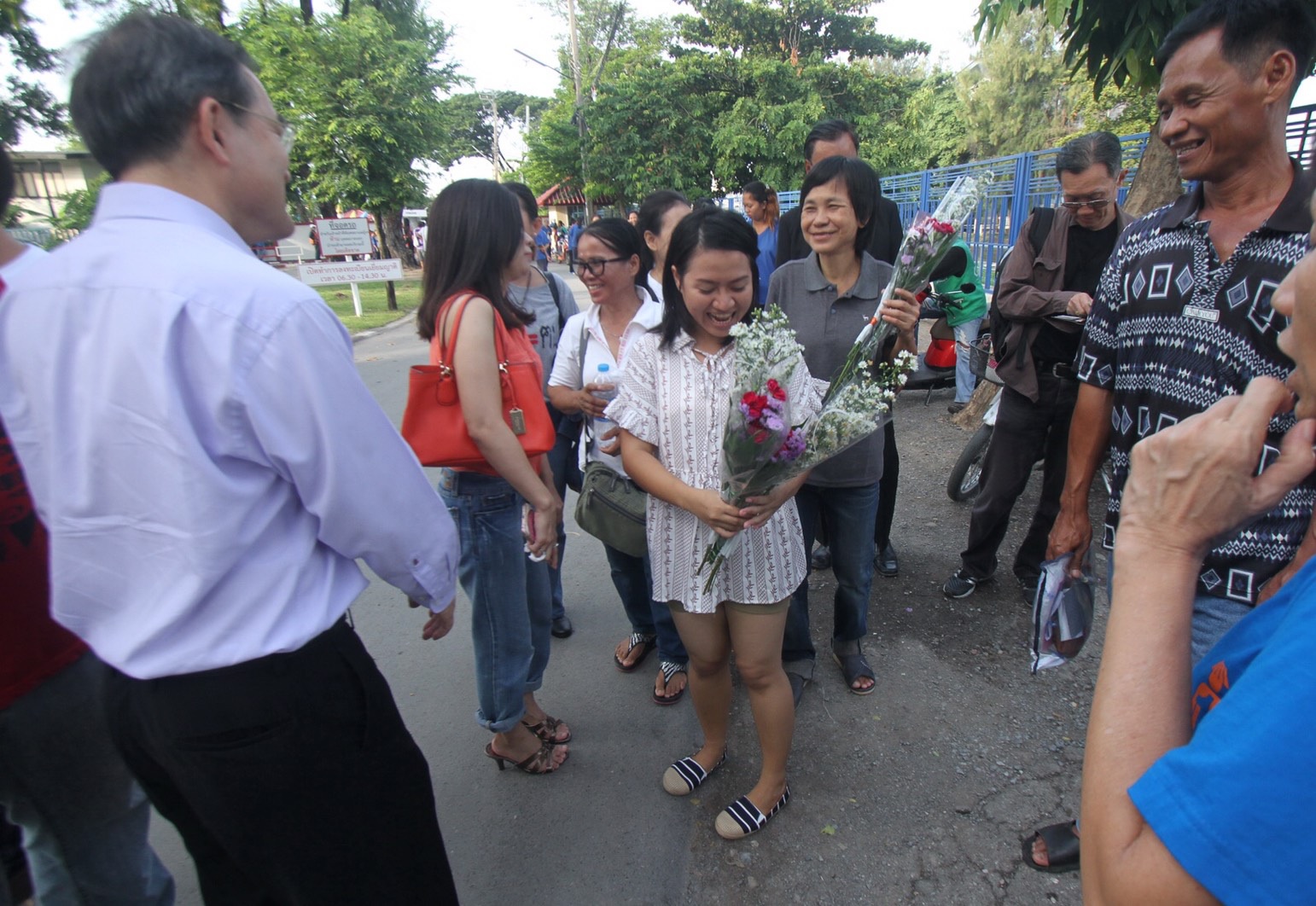
On 27 August 2016, Bangkok Post reported that Daranee Charnchoensilpakul (Da Torpedo), Pornthip Munkong (Golf) and Thitinant Kaewchantranont have been released from prison.


Pornthip Munkong, in white with flowers, and Daranee Charnchoensilpakul, in grey with flowers, outside the central prison Saturday morning in Bangkok. Photo: Matichon


1. Ms Daranee Charnchoengsilpakul, better known as "Da Torpedo", was sentenced to 15 years for insulting the monarchy. She had been behind bars for eight years, three of them spent awaiting trial and sentencing.

Ms. Chancherngsilpakul  is also known as “Da Torpedo”, former journalist at Pimthai Newspapers and Thai Sky Cable TV. Before detention, Ms. Chancherngsilpakul  was a political activist from Democratic Alliance Against Dictatorship (DAAD), former name of United Front of Democracy Against Dictatorship (UDD).Da Torpedo was accused of making a public speech at Sanam Luang with words deemed transgressing the Lese Majeste law  in July 2008. Sondhi Limthongkul, an ultra-royalist media firebrand, quoted what Ms Daranee had said at one of his own talks and the army filed the complaint against Ms Daranee the next day.

2. Ms Pornthip Munkong (Golf) was charged with lese majeste after she directed the play The Wolf's Bride at an event held on Oct 13, 2013 at Thammasat University to commemorate the 40th anniversary of the Oct 14, 1973 uprising.
The privately set up Royal Monarch Alert Protection Network filed a complaint against Ms Pornthip and one of the actors. After a crackdown on lese majeste offenders following the May 22, 2014 coup, Ms Pornthip was arrested at Hat Yai airport on Aug 15, 2014.
She confessed to the crime and was sentenced on Feb 28, 2013 to five years in jail, commuted by half because she confessed. Like Ms Daranee, she was denied bail during the trial.

3. Mrs Thitinan Kaewchantranont, who was said to suffer from mental illness, was found guilty of treading on an image of HM the King when several groups of protesters gathered in front of the Constitutional Court office in July 2012. 
In May 2014, the Court of First Instance found Thitinan K. guilty of lèse majesté and sentenced her to two years in jail, but since the defendant pleaded guilty, the jail term was halved. As the defendant suffered from a mental illness, the jail term was suspended for three years. The court also required the defendant to report to the court every six months during the three years.

On 13 July 2012, about 400 protesters, both pro- and anti-establishment, gathered at the Constitutional Court compound when the court was scheduled to read its ruling on the Pheu Thai Party’s attempt to amend Article 68 of the charter. Anti-establishment, pro-Pheu Thai red-shirt protesters gathered to pressure the court, while another pro-establishment group came to show support for the court. 

Thitinan kicked at the King’s image while a protester was holding it. When the image fell to the ground, she then stepped on it twice. 

According to Weeranan Huadsri of Thai Lawyers for Human Rights , the three were included in a royal pardon under which 100 female prisoners were released.

Sunday, 7 February 2016

UN body demands immediate release of lèse-majesté detainee

FIDH 's press release on 4 February 2016

(Paris, Bangkok) A UN body has requested that Thailand immediately release lèse-majesté detainee Pornthip Munkong aka Golf and award her compensation for the arbitrary detention she has been subjected to, according to information received by FIDH.
In an opinion adopted on 2 December 2015, the UN Working Group on Arbitrary Detention (UNWGAD) declared that Golf’s detention is arbitrary because it contravenes Articles 9 and 19 of the Universal Declaration of Human Rights (UDHR) and Articles 9(3) and 19(2) of the International Covenant on Civil and Political Rights (ICCPR). Thailand is a state party to the ICCPR. The referenced provisions guarantee the fundamental right to liberty, the right to a fair trial, and the right to freedom of opinion and expression.


On 23 February 2015, the Bangkok Criminal Court sentenced Golf to two and a half years in prison under Article 112 of Thailand’s Criminal Code. Article 112 states that “whoever defames, insults or threatens the King, the Queen, the Heir to the throne or the Regent shall be punished with imprisonment of three to 15 years.” Golf was found guilty of committing lèse-majesté for performing in a political play calledJao Sao Maa Paa [‘Wolf’s Bride’] at Bangkok’s Thammasat University in October 2013. The play, which centered on a fictional monarchy, was deemed to have insulted King Bhumibol Adulyadej.

Golf is currently incarcerated at the Central Women’s Correctional Institution in Bangkok. She has been deprived of her liberty since her arrest on 15 August 2014 at Hat Yai International Airport, Songkhla Province.

Golf is the third Thai lèse-majesté detainee whose deprivation of liberty has been declared arbitrary by the UNWGAD.

On 19 November 2014, the UNWGAD declared that the detention of student activist Patiwat Saraiyaem aka Bank was arbitrary. Bank was arrested on 14 August 2014 on lèse-majesté charges for his participation in the Jao Sao Maa Paa play. On 23 February 2015, he was sentenced to two and a half years in prison.

On 30 August 2012, the UNWGAD determined that the detention of former labor activist Somyot Phrueksakasemsuk was arbitrary. Somyot was arrested on 30 April 2011 for allowing the publication of two satirical articles that were deemed to have insulted the monarchy in the magazine for which he was the editor. On 23 January 2013, Somyot was sentenced to 10 years in prison on two counts of lèse-majesté.

As in the case of Golf, the UNWGAD urged the Thai government to immediately release Bank and Somyot and to accord them compensation.

Under the current ruling military junta, the National Council for Peace and Order (NCPO), the number of individuals detained or imprisoned under Article 112 has significantly increased. Since the 22 May 2014 military coup, at least 35 individuals have been sentenced to prison terms for violating Article 112. [1] Twenty-three of them were tried by military courts. In addition, at least 22 individuals are detained awaiting trial on lèse-majesté charges. At the time of the 22 May 2014 coup, there were six individuals behind bars on lèse-majesté charges.